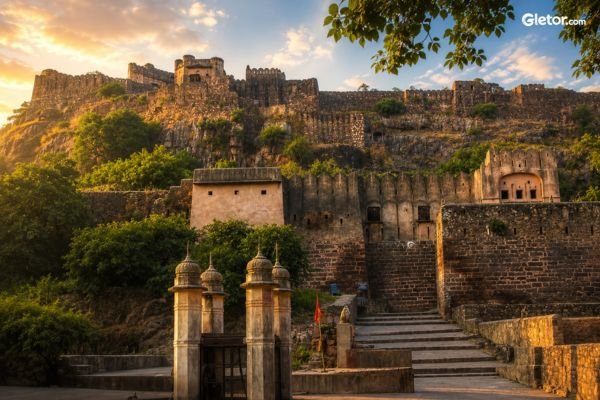
A fort built to be difficult
The Chauhan kings put Ranthambore Fort on top of a crag roughly 700 feet above the plain in the mid-10th century, at a time when the plateau below was thick forest rather than the scrub and grassland you drive through now. The choice was about defence: one narrow approach, cliffs on three sides, and a garrison that could hold the top against anything sent up the hill.
For about three hundred years that worked. Delhi Sultanate armies came and went. Akbar took the fort in 1568 after a long campaign, and the Mughal period that followed turned it into an imperial outpost — which is why there is a mosque on the plateau alongside the Jain temples. The fort eventually passed to the Hada Rajputs and then to the Kachwahas of Jaipur, who kept the surrounding forest as hunting ground for generations before it became a reserve.
It was inscribed by UNESCO in 2013 as one of the six Hill Forts of Rajasthan, with Chittorgarh, Kumbhalgarh, Gagron, Amber and Jaisalmer. The designation protects the site, but it does not make it easy to reach: the fort is inside the national park, and the only way in is on a vehicle with a permit for that date.
How the visit actually works
You reach the fort on a park safari vehicle, usually in the first hour of the drive rather than at the end. The vehicle stops at the foot of the hill, and from there it is a climb of roughly 700 uneven stone steps to the main gate. There is a caretaker at the top who takes your permit details. Allow an hour to an hour and a half for the whole thing, and expect to be walking on rubble rather than pavement for most of it.
Wear shoes you can grip on loose stone, and take water. There is no shop at the top. The stepwells inside the fort held water for sieges and are now dry, interesting to look at and not drinkable.
What is worth the climb
Trinetra Ganesh Temple
A 12th-century shrine in red Karauli stone where Ganesha is carved with three eyes. It draws a crowd every Wednesday, and it is the reason most people come.
Raj Bagh Ruins
The remains of the palace complex in the northern corner, now roofless and full of scrub. The scale of the courtyards tells you what the fort looked like before it was abandoned.
Padam Talao
The large lake at the foot of the hill, and the best waterhole in the park for winter birdlife. Deer come down to drink in the early morning.
Jain temples
Two working Jain shrines on the plateau, dedicated to Sumatinath and Sambhavanath, with carved columns and a quiet courtyard that is a change of pace from the climb.
Architecture worth slowing down for
The fort runs about 12 kilometres around its walls, which is a lot of ground for a small group to cover. You will not see all of it, and nobody expects you to. Concentrate on three places: Toran Dwar, the main entrance, where the gate is still intact and the scale of the approach is obvious; the Mahadeo Chhatri and Sametonki Haveli, which show the domestic side of a royal garrison town rather than its walls; and the old stepwells, which explain how the fort survived a siege without a supply line.
The water system is the detail most visitors miss. A fort that held out for months had to store and protect a year's supply in a fixed place, and the tanks and stepwells scattered across the plateau are the answer. Once you see where they are relative to the living quarters, the rest of the layout makes sense.
The views from the top are the other draw. From the western wall you look straight down into the park — forest, grassland and the lake, with the tiger territories laid out below you. It is the single best free view in Ranthambore and you get it from the same vehicle you arrived in.